 Belfast One
The Story of Belfast
Chapter 1 · c. 1720–1769
Passagassawakeag: The Land Before Belfast
The tidal river that runs past today's Armistice Footbridge has the oldest name in town: the Passagassawakeag. In colonial deeds the whole tract at the head of the bay went by that name, part of the enormous Muscongus grant that Boston merchant and soldier Samuel Waldo acquired around 1720 and that became known as the Waldo Patent.
Waldo's heirs sold the Passagassawakeag lands to a group of Scots-Irish proprietors from Londonderry, New Hampshire. Surveyor Joseph Chadwick laid out the first plan in 1768, and on August 29, 1769, the deed was issued to the sixteen "Original Proprietors" for 97,359 acres. Waldo's name lives on in the county Belfast now anchors; the river's name lives on in the rail trail along its banks.
Chapter 2 · 1770–1773
The Scots-Irish Settlers of 1770
Belfast began with roughly thirty people stepping ashore in the spring of 1770. They were Scots-Irish families from Londonderry, New Hampshire — descendants of Ulster Presbyterians who had already crossed one ocean and now pushed north up the coast to the lands their proprietors had bought.
The first winter was hard and the record is spare. In December 1770 John Morrison and Thomas Steele drowned in the bay, the settlement's first recorded deaths; on May 9, 1772, Ann Patterson became the first child born to the settlers. By 1773 the community was ready for self-government: the General Court granted its petition to incorporate as a town in June, and the first town meeting followed on November 11, 1773. (Sources give June 21 and June 29 for the incorporation date.)
Sources
Some details in this chapter are still being verified.
Chapter 3 · 1773
Belfast or Londonderry? The Penny Toss
Every Belfast resident eventually hears the story. When it came time to name the new town, many of the Londonderry families wanted to honor their New Hampshire home. James Miller, who had come from Belfast in Ireland, was just as determined — some accounts say forceful — that the town should carry his birthplace's name.
Tradition says the matter was settled the fairest way frontier people knew: someone tossed a penny, and Belfast won. The Belfast Historical Society presents the story as tradition, and no document from 1773 records the toss itself. Whether or not a coin ever spun in the air, the name stuck — and it is why a midcoast Maine city shares its name with the capital of Northern Ireland.
Sources
Some details in this chapter are still being verified.
Chapter 4 · 1779–1784
The Revolution Empties the Town
The Revolution reached Penobscot Bay in August 1779, when British troops occupied Bagaduce — today's Castine — just across the water. For an exposed young settlement of patriot families, the threat was immediate. Belfast's settlers left, and the town stood largely empty for about five years.
Accounts differ on how much was destroyed: Wikipedia says the British burned Belfast in 1779, while the Belfast Historical Society's history speaks of abandonment. Either way, the 1780s were a second founding, as families came back to clear and rebuild what they had left behind.
Sources
Some details in this chapter are still being verified.
Chapter 5 · 1793–c. 1900
The Jenny Miller and the Birth of a Shipbuilding Town
In 1793 Belfast launched its first ship, the Jenny Miller, and a town of farmers became a town of shipwrights. Through the 1800s the waterfront filled with yards, sail lofts and ropewalks; at its height, as much as thirty percent of Belfast's men earned their living in the maritime trades.
Belfast yards turned out hundreds of three-, four- and five-masted schooners, and the profits built the captains' and merchants' houses that still line Church, High and Congress streets. The age of wood and sail ended around 1900, but it left Belfast its architecture, its fortunes and its identity as a harbor town — an identity revived a century later at French & Webb and Front Street Shipyard.
Chapter 6 · 1818
First Church of Belfast (1818)
The white steeple at the head of Church Street is Belfast's oldest civic landmark. Master builder Samuel French completed the First Church in 1818, in the refined Federal style the new republic favored.
It anchors the north end of the Belfast Historic District and is still a living building — in October 2025 it hosted the Belfast Poetry Festival's keynote reading.
Chapter 7 · 1814
Five Days Under the Union Jack, 1814
Belfast's second brush with British occupation came in the late summer of 1814. As British forces swept up the coast — taking Machias, Castine and Belfast and raiding Hampden and Bangor — a force of about 600 men under General Gosselin entered Belfast around September 1. There was no battle; the town surrendered, and some 1,200 militiamen gathered a few miles outside to wait and watch.
The occupation lasted five days before the troops moved on. Two centuries later, in 2014, Belfast marked the anniversary of its 'inglorious surrender' with good humor.
Sources
Some details in this chapter are still being verified.
Chapter 8 · 1827
Shire Town of Waldo County
When Waldo County was organized in 1827, Belfast — already the area's busiest port and market town — became its shire town. The courts, the registry and the county's business all came to the head of the bay.
A generation of civic buildings followed in the 1850s: City Hall, the Waldo County Courthouse, and the granite Customhouse and Post Office. Not every boundary held, though; in 1845 a piece of Belfast was set off to help create neighboring Searsport.
Chapter 9 · 1857
Ammi B. Young's Customhouse and Post Office
Ports that earned the federal government real revenue got real buildings, and in 1857 Belfast got one of the best: a Customhouse and Post Office designed by Ammi B. Young, the Treasury Department's supervising architect, whose customhouses rose in harbors from Maine to the Gulf.
It stood as a monument to the shipping boom that filled Belfast's harbor with schooners and its treasury with duties, and today it is one of the signature buildings of the historic downtown.
Chapter 10 · 1850–1853
From Town to City
By mid-century Belfast's shipbuilding wealth had made it too big for town meeting. Belfast became one of Maine's first cities — the eighth, by Wikipedia's count — but the date depends on whom you ask: Wikipedia gives a city incorporation of August 17, 1850 and a charter adopted April 3, 1852, while the National Register district history and many local accounts say 1853.
The discrepancy likely reflects the gap between legislative approval and local acceptance of the charter. Until it is confirmed with the city, the app should present this as 'the early 1850s.'
Sources
Some details in this chapter are still being verified.
Chapter 11 · 1865–1866
The Great Fire of 1865
Just months after the Civil War ended, Belfast lost its heart. On the night of October 12, 1865, fire broke out on the waterfront and swept uphill, consuming about 125 buildings across some twenty acres of downtown.
The city's response shaped the Belfast visitors see today. In 1866 it banned new wooden buildings in the downtown, and merchants rebuilt in brick. Mayor Axel Hayford led the way with the Hayford Block on Church Street — built in 1866 and enlarged in 1869, with an opera house inside — the first significant construction after the fire and now on the National Register.
Chapter 12 · 1873–present
1873 and the Best Brick Downtown in Maine
Eight years after the Great Fire, flames tore through downtown again in 1873. Once more Belfast rebuilt, and once more it built in brick — producing the dense, handsome Main Street and Church Street blocks that survive almost intact.
The Belfast Historical Society calls the result the best extant brick commercial district in Maine. The Belfast Commercial Historic District, along Main Street from Church Street to Washington Street, was listed on the National Register of Historic Places in 1980; the Hayford Block had been listed on its own in 1977.
Sources
Chapter 13 · 1800s–present
Federal, Greek Revival and Italianate: The Historic Districts
Shipbuilding money built Belfast's houses, and almost none of them were torn down. Walk up Church, High or Congress streets and you move through Federal, Greek Revival and Italianate homes of sea captains, merchants and shipbuilders — one of the largest concentrations of pre-Civil War architecture in Maine.
The Church Street Historic District, whose houses date mostly from 1840 to 1870, was listed on the National Register in 1978. The larger, 126-acre Belfast Historic District followed in 1986, with boundary increases in 1993 and 1995. Standouts include the 1842 Greek Revival James P. White House by local architect Calvin Ryder.
Sources
Chapter 14 · 1867–present
The Belfast & Moosehead Lake Railroad
Belfast never intended to be left at the end of the road. In 1867 the city chartered its own railroad, the Belfast & Moosehead Lake, and by about 1870-71 it ran 33 miles inland to the Maine Central main line at Burnham. The Maine Central operated it under a long lease from 1876 to 1926, after which the B&ML ran its own trains again.
Passenger service ended in 1960 and freight dwindled; by 2005 the Belfast yard was torn up. The old railyard became Front Street Shipyard in 2011, and in 2016 the Belfast Rail Trail opened on the right-of-way along the Passagassawakeag. Inland, the nonprofit Brooks Preservation Society still runs heritage excursions on the line.
Sources
- Belfast, Maine — Wikipedia
- History of Belfast — Belfast Historical Society & Museum
- Belfast and Moosehead Lake Railroad — Wikipedia
Some details in this chapter are still being verified.
Chapter 15 · 1887–1888
A Benevolent Bequest: Belfast Free Library
Belfast's library is a gift from two of its own. Residents Paul R. Hazeltine and Nathaniel Wilson left a combined $20,000 for a public library, and on February 3, 1887 the Maine Legislature chartered the Belfast Free Library.
Its building rose on the old Robert Miller homestead on High Street to plans by J. Munchwitz of New York, and it opened in May 1888 with 14,000 volumes and Miss Elizabeth Pond as librarian. It remains at 106 High Street today.
Chapter 16 · 1912–present
The Colonial Theatre and Hawthorne the Elephant
Movies have flickered at the Colonial since 1912. Rebuilt after a fire in 1924 and given its streamlined facade in 1947, the theater on High Street later split into three screens and became one of the oldest operating cinemas in Maine.
Its mascot arrived in 1997, when owners Therese Bagnardi and Michael Hurley bought a fiberglass elephant at the auction of Perry's Nut House's curiosities and hoisted it onto the roof. Named Hawthorne, it became a Belfast icon. After the owners' farewell screening in 2022, the community rallied: with a $1 million loan from local couple Bill and Libby Catania, the new nonprofit Hawthorne Theatre & Arts Collaborative bought the theater and reopened it in November 2023.
Sources
- Historical marker — HMdb
- Colonial Theatre safety upgrades — Bangor Daily News (2024)
- The Curtain Comes Down — Down East
Some details in this chapter are still being verified.
Chapter 17 · 1926/1927–present
Perry's Nut House
For anyone who drove Route 1 to Bar Harbor in the 20th century, Perry's Nut House was a required stop: a shop of exotic nuts from around the world, stuffed animals of every description, and a gorilla named Ape-Raham. Wikipedia dates it to 1927; the Belfast Museum's timeline says it opened in 1926.
In 1997 owners Diane and John Bailey auctioned most of the collection — one buyer took home the elephant that now tops the Colonial Theatre. New owners reopened Perry's in 2004 selling nuts and fudge, restored Ape-Raham in 2012, and put the business up for sale in 2017. Confirm its current status before listing it as open.
Sources
Some details in this chapter are still being verified.
Chapter 18 · 1940s–1988
Broiler Capital of the World
For a generation, Belfast smelled of chickens and was proud of it. After World War II, broiler processing took over the waterfront, led by Maplewood Poultry and Penobscot Poultry. Estimates of the volume range from 200,000 to 250,000 birds a day, and Belfast proudly billed itself the 'Broiler Capital of the World.' Feed came in by sea and rail to towering silos; growers across Waldo County raised the birds.
The decline came in stages. Maplewood closed in 1982 and its holdings were auctioned; the great feed mill came down in early 1984. Penobscot Poultry closed in early 1988, putting 400 more people out of work. (Wikipedia places the collapse in the mid-1970s, which conflicts with these later closure dates.)
Sources
- History of Belfast — Belfast Historical Society & Museum
- Broiler Capital of the World marker
- The last of the chicken farmers — Bangor Daily News
Some details in this chapter are still being verified.
Chapter 19 · 1948–2005
Broiler Day, the Broiler Queen and the Bay Festival
In 1948 Belfast threw itself a party to celebrate the industry that fed it. Maine Broiler Day, organized with the Maine Poultry Improvement Association, the Chamber of Commerce and the state agriculture department, brought thousands to town every July for barbecued chicken by the ton. From 1949 a Poultry Queen — later the Broiler Queen — was crowned.
As the chicken plants closed, the festival changed with the town, becoming the Bay Festival in the late 1980s. Its last edition was held at Belfast City Park in 2005. Today's waterfront festivals — Arts in the Park, the Celtic Celebration and Harbor Fest — carry on the summer tradition.
Sources
Chapter 20 · late 1800s–2001
Sardines, Shoes and the Industrial Waterfront
When the schooner yards went quiet, Belfast turned to what the bay itself provided. Ice harvesting and refrigeration let packers ship lobster, scallops, sardines, herring and mackerel to Boston and New York, and by the 1950s poultry, sardine and potato plants lined the waterfront beside a four-story shoe factory.
The last of that era went quietly. The Stinson family sold its sardine canneries in 1990, and after Connors Bros. bought them the Belfast plant closed — 2001, according to Maine Memory. A former cannery worker recalled that the canneries, the poultry plants and the shoe factories all seemed to end at once. The cannery site became part of Front Street Shipyard in 2011.
Sources
- Belfast, Maine — Wikipedia
- A sardine packing plant's 20th-century history — Island Institute
- History of Belfast — Belfast Historical Society & Museum
Some details in this chapter are still being verified.
Chapter 21 · 1960s–1990s
Hard Times and the Belfast Renaissance
The middle of the 20th century was hard on Belfast. Route 1 bypassed downtown in 1962, factories closed, and from the 1960s through the 1980s people left to find work elsewhere. Storefronts emptied on the brick blocks the 19th century had built so solidly.
What came next made Belfast what it is. Back-to-the-land homesteaders, artists, craftspeople and recent college graduates moved in, drawn by cheap space and the beauty of the bay. A 1983 Community Development Block Grant funded downtown revitalization, and by 1985 a facelift was underway. Hollywood noticed too — Belfast had already played a part in Peyton Place (1957) and later appeared in Thinner (1996) and In the Bedroom (2001) — and documentarian Frederick Wiseman profiled the city's everyday life in Belfast, Maine (1999).
Chapter 22 · 1990s–2006
MBNA and the Credit-Card Era
In the 1990s an unlikely employer came to the midcoast. MBNA, the Delaware credit-card bank led by Charles Cawley, set up operations in Belfast, eventually building two campuses — the main buildings rose between 1997 and 2000 on about 141 acres — and employing more than 2,000 people at the peak.
The effect on a city of under 7,000 was enormous: jobs, philanthropy, new housing and new money in local shops. MBNA also built the University of Maine's Hutchinson Center. When Bank of America acquired MBNA in 2006, the era of the 'MBNA town' ended, but the campuses and their legacy remained.
Sources
- Belfast, Maine — Wikipedia
- Belfast still benefiting from defunct MBNA — Bangor Daily News (2015)
- MBNA — Wikipedia
Some details in this chapter are still being verified.
Chapter 23 · 2006–present
After MBNA: Bank of America and athenahealth
When Bank of America bought MBNA in 2006 it kept Belfast, folding operations into the larger of the two campuses and shrinking over the years to roughly 800 workers by 2018. The smaller campus found a new life with athenahealth, the medical-software company, which hired many former MBNA employees and by 2018 was nearing 1,000 workers in Belfast. Sources differ on when athenahealth arrived (2005, 2007 or 2008).
The campuses continue to evolve: in 2021 Penobscot Community Health Care moved to purchase the former Bank of America complex.
Sources
- athenahealth helps Belfast recover — Bangor Daily News (2018)
- Health center poised to purchase former Bank of America complex — BDN (2021)
Some details in this chapter are still being verified.
Chapter 24 · 2000–present
The Hutchinson Center
The Hutchinson Center was MBNA's gift to the region's future. Conceived by MBNA chief Charles Cawley and University of Maine President Fred Hutchinson, it opened in July 2000 on land that had once been a chicken farm — a neat symbol of Belfast's transformation. MBNA paid for its construction, estimated at over $12 million, and rented it to the university for $1 a year.
Bank of America donated the center to the University of Maine System on June 27, 2006, and a $4 million wing named for Cawley's grandfather Edward J. Walsh was added in 2009. Years later UMaine announced it would close and sell the center, drawing objections from residents; its current status should be confirmed.
Sources
Some details in this chapter are still being verified.
Chapter 25 · 1996–present
Shipbuilding Reborn: French & Webb and Front Street Shipyard
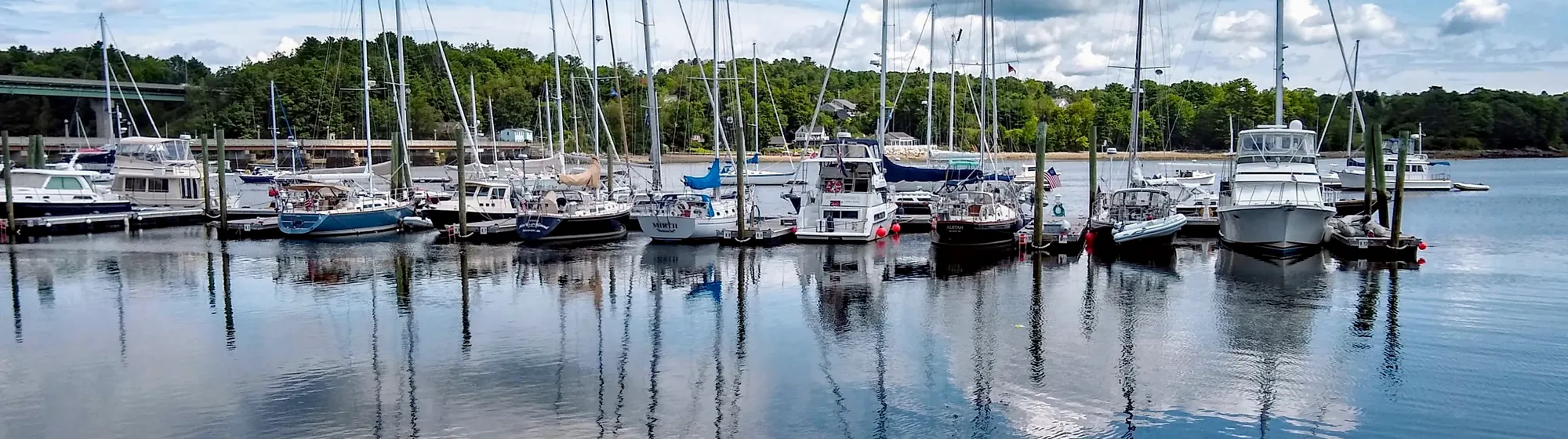
Belfast's waterfront came full circle. In 1996 French & Webb began building and restoring classic wooden yachts, reestablishing boatbuilding on the harbor. Then, in January 2011, a group of maritime professionals led by JB Turner — with partners including Taylor Allen of Rockport Marine — launched Front Street Shipyard on the graffiti-covered ruins of the Stinson cannery and the old railyard.
The yard grew fast: it bought the neighboring Belfast Boat Yard in 2012 and in 2013 added a 485-US-ton travel lift, the largest motorized boat hoist north of Newport, Rhode Island, able to haul superyachts. Today big boats on the hard beside the Harbor Walk are one of the most photographed sights in town.
Sources
Chapter 26 · 2011–present
Our Town Belfast and the 'Coolest Small Town'
In 2011 Belfast was designated a Main Street Maine community, joining a statewide network of downtowns committed to preservation-based revitalization. Its program is run by Our Town Belfast, a nationally accredited Main Street nonprofit that has filled downtown with public art — artist-painted crosswalks, a trail of whimsical Tiny Doors, and fifteen painted chairs along Main Street.
The revival got national attention: the Belfast Area Chamber of Commerce and Visit Maine both note that USA Today named Belfast one of America's 'Coolest Small Towns.' (The year of that recognition has not been confirmed.)
Sources
- Belfast — Belfast Area Chamber of Commerce
- Main Street Maine community — Bangor Daily News (2011)
- Belfast, Maine — Main Street Maine
Some details in this chapter are still being verified.
Chapter 27 · Geologic / studied 1989–present
The Mysterious Pockmarks of Belfast Bay
Beneath the calm water of Belfast Bay lies one of the strangest landscapes in New England. The muddy bottom is pitted with thousands of craters — 'pockmarks' — from 10 to 300 meters across and averaging nearly eight meters deep. A 1989 U.S. Geological Survey study described hundreds of them near the head of Penobscot Bay; later mapping counted roughly 2,300.
Scientists link the pockmarks to gas escaping from the mud, though they appear largely inactive today, and nearly half line up in chains. The USGS and NOAA have returned again and again to map the field, making Belfast Bay a textbook example studied by marine geologists worldwide.
Sources
Chapter 28 · 1800s–present
Notable Belfast People
For a small city, Belfast has an outsized roster. It gave Maine two governors — Hugh J. Anderson, the 20th, and William G. Crosby, the 23rd — and the U.S. Navy a Chief of Naval Operations in Adm. William Veazie Pratt. Albert William Stevens pushed the frontier of high-altitude ballooning and aerial photography, and Edward Wilson Very invented the signal flare gun that bears his name.
The town's own story was preserved by Joseph Williamson, author of the History of Belfast. In more recent times, actors Jonathan Frakes and Genie Francis have called Belfast home.
Know something we should add or correct? Tell us.